Man is a rope stretched between animal and Superman
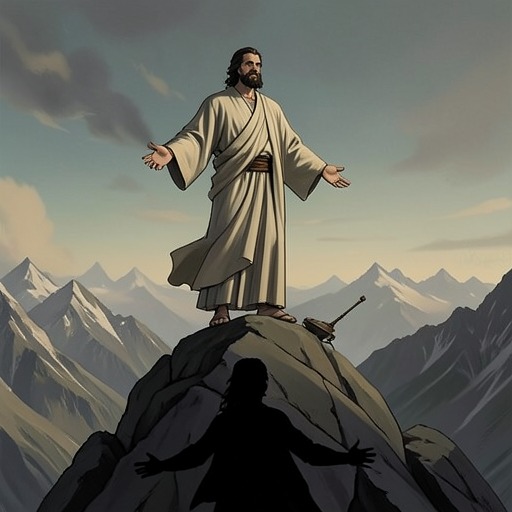
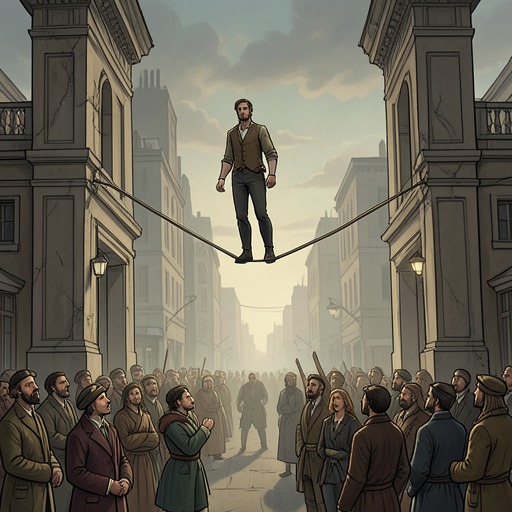
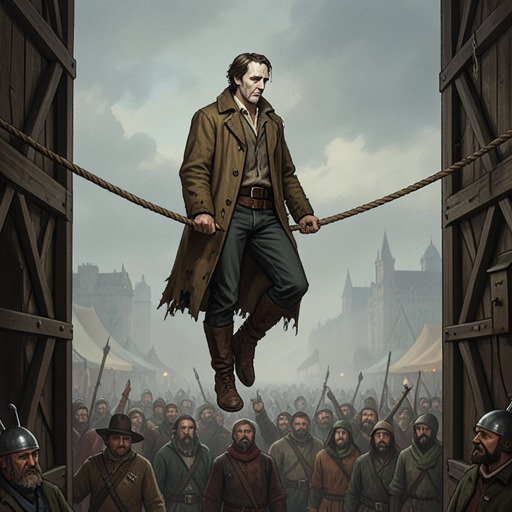
Thus Spoke ZarathustraZarathustra’s image of humanity as a rope stretched between animal and Superman makes human existence a passage rather than an achievement. The rope hangs over an abyss: crossing it means exposure to danger, and humanity’s significance lies not in arriving at a settled destination but in becoming a bridge toward what exceeds it.
The Image of the Rope
The image joins two opposed ideas. A rope is a connection across a gap, but it is also precarious: Zarathustra describes the crossing as dangerous wayfaring, looking back, shuddering, and staying still. The abyss gives the passage its stakes. Humanity is neither safely grounded at its starting point nor guaranteed a secure landing; even hesitation belongs to the hazards of the crossing.
The phrase’s force depends on that instability. It does not describe humanity as a completed form with a fixed place in the world. Instead, the human is positioned between animal and Superman, with the distance between them represented as something to be crossed. The image makes transition central and denies that mere human existence is the endpoint of the movement.
From Animal to Superman
The surrounding teaching supplies the direction of the passage. Zarathustra says that creatures have created something beyond themselves, then warns his audience against becoming the ebb of this tide and returning to animals rather than overcoming humanity. He compares humanity’s relation to the Superman with the ape’s relation to human beings: the ape is a laughing-stock or painful embarrassment, and humanity may occupy the same position in relation to what follows it.
The comparison draws on a sequence from worm to human and points toward a further transformation. Yet the passage is not simply a claim about biological descent. Its language turns the animal-to-human sequence into a challenge about what humanity does with its present condition: people remain animal-like in important respects, and the wise person is still described as a discordant hybrid of plant and ghost. Zarathustra rejects both regression and the abandonment of earthly life for a ghostly or plant-like ideal, insisting instead on overcoming the human condition.
Bridge, Not Goal
Zarathustra makes the image explicit by calling what is great in humanity its status as a bridge rather than a goal. What can be loved in humanity is its going-across and down-going: value lies in movement beyond the self, not in human beings’ claim to be the final measure of existence. This distinction explains why the crossing is dangerous without making danger an accidental obstacle. The risk belongs to the passage itself.
The related image of people who cannot live except through their down-going extends the metaphor into a human type. Zarathustra loves those who accept their lives as a going-across, and he calls the great despisers venerators and arrows of longing for the other bank. Their rejection of the merely human is directed toward a more distant possibility; it is not simply a wish to destroy what exists. In this imagery, descent and forward movement belong together: the passage requires leaving a settled position behind.
The Name and the Reversal of Morality
The expression appears within a teaching delivered by Zarathustra, whose name carries a deliberate philosophical reversal. Nietzsche identifies the historical Zarathustra with the first interpretation of the struggle between good and evil as the underlying structure of things, and therefore with morality’s creation. In Nietzsche’s account, the name becomes appropriate for a figure who must recognize and overcome the moral error associated with its bearer. The rope image’s demand to pass beyond humanity consequently belongs to a broader effort to move beyond inherited moral conclusions, rather than to treat existing human values as the final destination.
The passage thus binds together its central contrasts: animal and Superman, abyss and crossing, goal and bridge, descent and longing for another bank. Humanity matters as an unfinished transition. Its danger is also its possibility: to stop, regress, or mistake the bridge for the goal is to refuse the movement that gives human existence its meaning.